

How Does Infrared Thermal Imaging Work?
Infrared thermal imaging is a technology that creates images using the infrared radiation naturally emitted by objects. Every object with a temperature above absolute zero (-273.15°C or 0 Kelvin) emits infrared energy based on its temperature. This emitted infrared energy is known as the object's thermal signature. In general, the hotter the object, the more radiation it emits.
A thermal imaging camera is essentially a heat sensor capable of detecting and capturing tiny temperature differences. It collects infrared radiation from objects in a scene and creates pixels based on temperature variation information to form an image. Because objects rarely have exactly the same temperature as their surroundings, a thermal imager can detect these differences and produce a striking contrast in the thermal image.
Core Concept: Thermal imaging does not "see" heat in the traditional sense. Instead, it senses the infrared radiation emitted from an object's surface and converts it into a visible image. This is fundamentally different from conventional visible-light photography — thermal imaging works in complete darkness.
The Electromagnetic Spectrum and Infrared Bands
In the second half of the 19th century, scientists discovered that thermal radiation shares similar properties with other electromagnetic waves, such as visible light and radio waves. Subsequently, Kirchhoff, Stefan, Boltzmann, Wien, and Planck formulated the laws of radiation. By the mid-20th century, intensive and successful military applications of infrared technology led to the development of the first infrared viewers.
The electromagnetic spectrum spans an enormous range of frequencies, from radio waves and microwaves to infrared, visible light, ultraviolet, X-rays, and gamma rays. Infrared thermal imaging utilizes bands concentrated in the near-infrared to far-infrared range. The primary bands used for thermal imaging are:
| Band Name | Wavelength Range | Primary Applications |
|---|---|---|
| Short-Wave Infrared (SWIR) | 0.9 - 1.7 µm | Industrial inspection, semiconductor testing |
| Mid-Wave Infrared (MWIR) | 3 - 5 µm | High-temperature targets, military applications |
| Long-Wave Infrared (LWIR) | 8 - 14 µm | Room-temperature detection, security surveillance |
Among these, the Long-Wave Infrared (8~14 µm) range, known as the long-wave atmospheric window, maintains high transmittance over longer distances. However, measurable atmospheric attenuation already occurs in the 3~5 µm short-wave atmospheric window at distances of approximately ten meters.
Blackbody Radiation Laws and Physical Foundations
Real-world objects exhibit different radiation characteristics. In radiative physics, a "blackbody" is an idealized model with perfect radiation properties. Its unique feature is that among all objects at the same temperature, it emits the maximum possible radiation.
Planck's Law of Radiation
Planck's Law of Radiation describes the spectral distribution of blackbody radiation. The wavelength spectrum shifts as the object's temperature changes: objects hotter than 500°C also emit radiation in the visible light range. Furthermore, at every wavelength, radiation intensity increases as temperature rises.
Wien's Displacement Law
Graphical representations of Planck's Law show that the wavelength at which a blackbody emits maximum radiation shifts with temperature. Wien's Displacement Law can be derived by differentiating the Planck equation.
The lower the temperature of the measured object, the more its radiation peak shifts toward longer wavelengths — approximately 10 µm near room temperature. This is the primary reason thermal imagers typically operate in the long-wave infrared band.
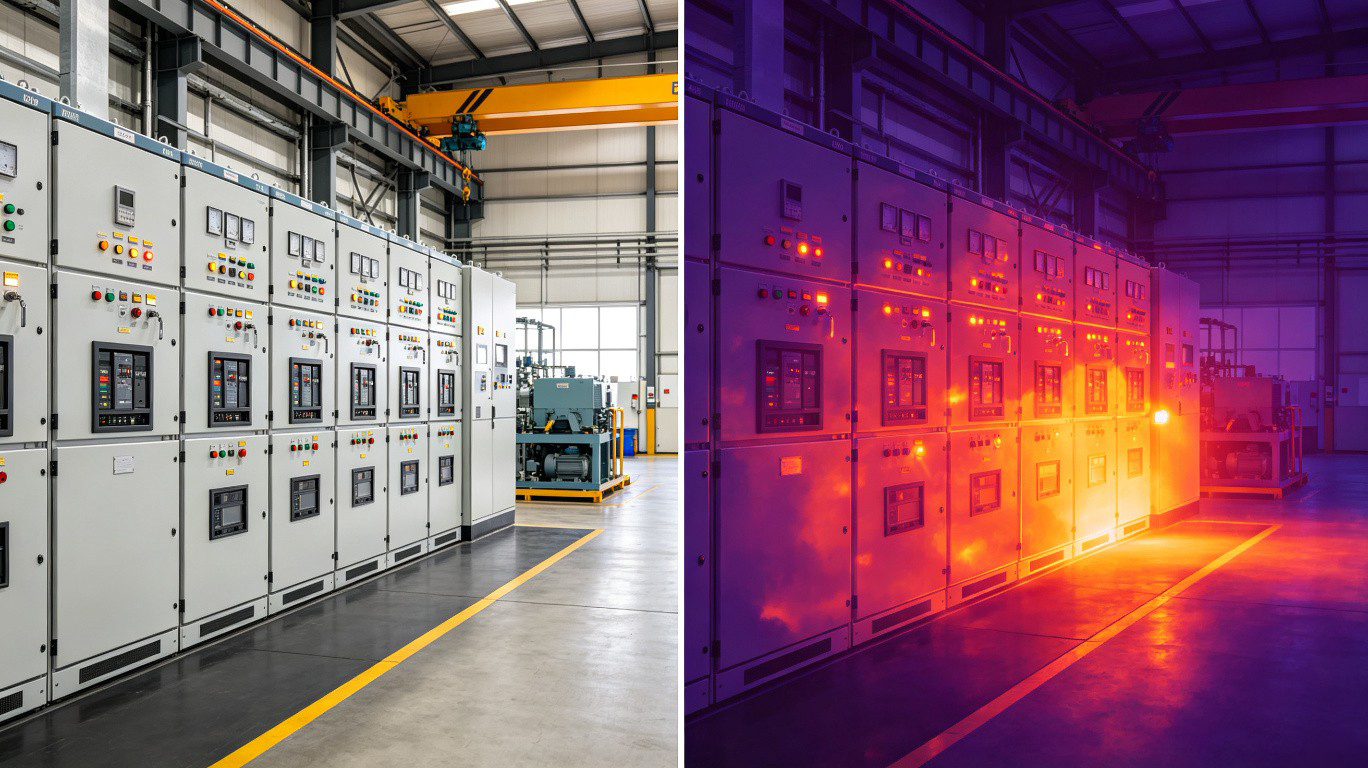
Figure: Visible light (left) vs. thermal imaging (right) comparison
The Impact of Atmospheric Windows
Air transmittance is highly wavelength-dependent. Regions of high attenuation alternate with regions of high transmittance, known as "atmospheric windows."
For thermal imaging applications, selecting the right operating band is critical. The Long-Wave Infrared (8~14 µm) band, called the "long-wave atmospheric window," offers higher transmittance and longer detection ranges.
Emissivity and Its Impact on Measurements
While the blackbody model is essential for understanding fundamental relationships, real-world objects deviate from this ideal to varying degrees. Therefore, it is necessary to account for these effects in measurements.
Emissivity is a measure of an object's ability to emit infrared radiation. A value of 1 represents the highest possible emissivity (the blackbody), and this value is wavelength-dependent. The emissivity of real objects may show strong wavelength dependence. Additional influencing parameters include:
- Temperature: The surface temperature of the object directly affects radiation intensity.
- Material Composition: Different materials exhibit significantly different emissivity values.
- Surface Oxidation: Oxide layers can alter surface radiation characteristics.
- Surface Roughness: Rougher surfaces generally have higher emissivity.
- Polarization: Affects the directional distribution of emitted radiation.
Many non-metallic materials, regardless of surface structure, display high and relatively constant emissivity — examples include human skin and paint. In contrast, metallic materials typically have low emissivity, which depends heavily on surface characteristics and decreases with increasing wavelength.
How a Thermal Imaging Camera Is Designed
An infrared thermal imaging camera's core front-end module consists of the following components. From the target object to the final display, the signal passes through these stages:
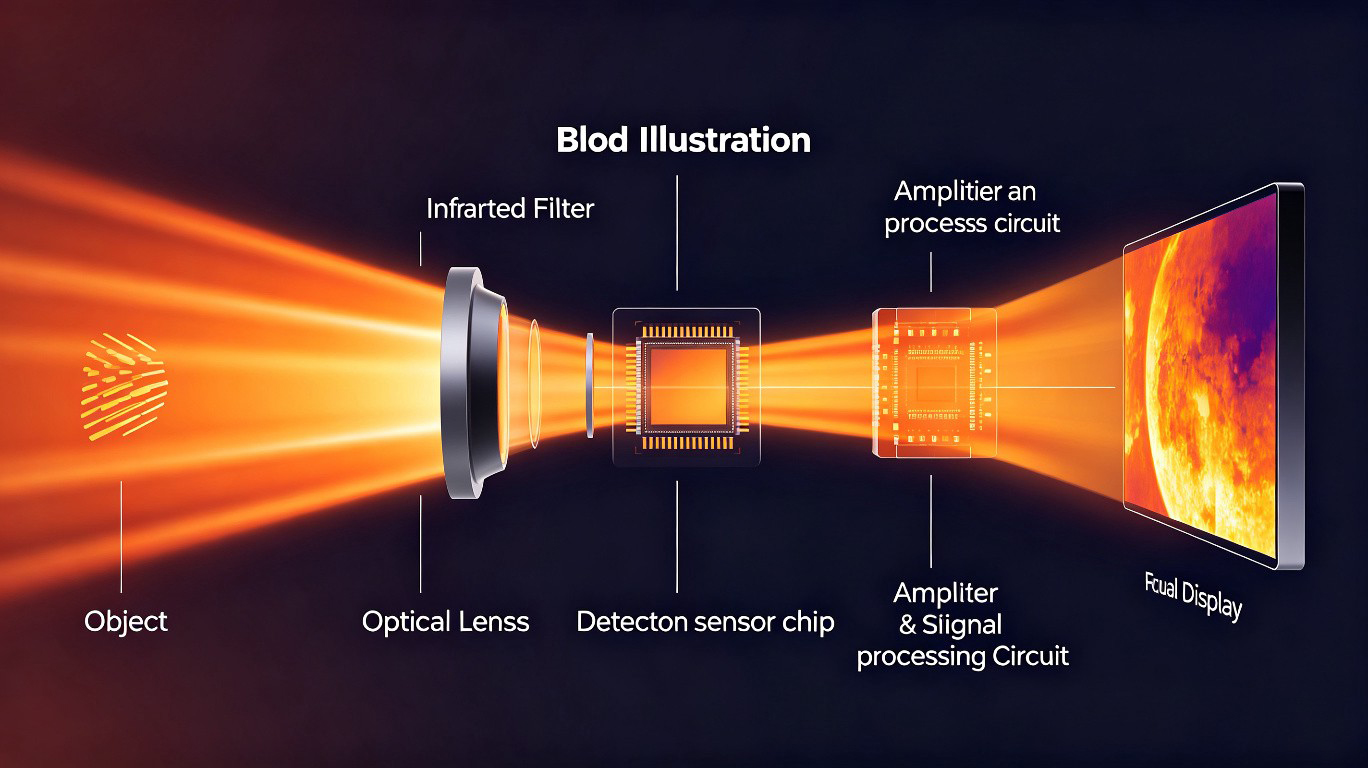
Figure: Optical path and component structure of a thermal imaging camera's core front-end module
Optical Lens Assembly
The lens gathers infrared energy and its design determines the camera's field of view and optical performance. Infrared optical lenses are typically made from special materials such as germanium (Ge) and zinc selenide (ZnSe), which offer high transmittance in the infrared spectrum.
Infrared Filter
The filter blocks unwanted energy from other wavelength bands, allowing only the effective infrared band to pass through. Filter selection directly determines the thermal imager's operating band (Long-Wave or Mid-Wave).
Infrared Detector (Sensor)
The detector converts infrared optical energy into electrical signals. Think of it as the CCD or CMOS in a standard smartphone camera. Today's mainstream uncooled infrared detectors use Vanadium Oxide (VOx) microbolometer technology.
Amplifier & Signal Processing
This stage amplifies electrical signals, performs analog-to-digital conversion, and applies algorithms to produce display-ready image data. This processing chain determines image quality, frame rate, and feature richness.
Real-Time Display
The final thermal image presented on the user's display. Modern thermal imagers offer multiple color palettes — White Hot, Black Hot, Iron, Rainbow — to suit different observation scenarios.
Key Specifications of Thermal Imaging Technology
When evaluating or purchasing a thermal imaging camera, the following core specifications determine device performance:
| Specification | Description | Typical Values / Impact |
|---|---|---|
| Resolution | Number of detector pixels | 384x288 / 640x512 / 1280x1024 — higher is sharper |
| NETD | Noise Equivalent Temperature Difference | <50mK is excellent; lower = higher sensitivity |
| Pixel Pitch | Physical size of a single pixel | 12µm / 17µm — smaller enables more compact designs |
| Frame Rate | Image refreshes per second | 25Hz / 30Hz / 50Hz / 60Hz |
| Temperature Range | Measurable temperature span | -20°C ~ +550°C (industrial models offer wider ranges) |
| Field of View | Angular coverage of the lens | Depends on focal length; adjustable with different lenses |
Applications of Thermal Imaging Technology
Thermal imaging applications are virtually everywhere. As leading security manufacturers like Hikvision, Dahua, and Dali have rapidly advanced their technology, and with continuous iteration of chip and sensor performance, thermal imaging cameras have become increasingly affordable — no longer out of reach for everyday users.
Fever Screening
Quickly detect individuals with elevated body temperatures in high-traffic areas. Non-contact measurement ensures safety and efficiency.
Power Grid Inspection
Identify thermal faults in high-voltage switchgear, distribution boxes, and power lines. A core tool for predictive maintenance.
Industrial Inspection
Monitor equipment overheating, detect pipe leaks, assess building energy efficiency, and inspect HVAC systems.
Security & Surveillance
All-weather perimeter protection, forest fire prevention, and border patrol — all without dependency on ambient lighting.
Medical & Healthcare
Assist in diagnosing inflammation, evaluating blood circulation, and early-stage breast cancer screening.
Search & Rescue
Locate trapped individuals through smoke during fire rescue operations, and conduct nighttime or wilderness search missions.
How to Choose Your First Thermal Imaging Camera
Thermal imaging devices share design principles with many surveillance products. Today, you can buy a highly practical model for around $150–$200. When selecting a thermal camera, focus on the following key factors:
- Define Your Application: Will you use it for industrial temperature measurement, security surveillance, or outdoor observation? Different scenarios demand different resolution, accuracy, and protection ratings.
- Choose the Right Resolution: A 384x288 resolution satisfies most daily needs. For long-range target identification, consider 640x512 or higher.
- Check the NETD: The lower the Noise Equivalent Temperature Difference, the higher the thermal sensitivity. For industrial applications, choose a product with NETD <40mK.
- Brand & After-Sales Support: Prioritize brands with comprehensive technical support and service networks. Infrared devices require periodic calibration and maintenance.
- Extended Features: WiFi transfer, photo/video recording, multiple color palettes, and spot/area temperature analysis can greatly enhance your experience.
Frequently Asked Questions
A: A thermal imaging camera detects the infrared radiation emitted by objects and requires no light source at all — it works in complete darkness. Traditional night vision (image intensification) amplifies tiny amounts of ambient light and cannot function in total darkness. Thermal imaging can also penetrate smoke and light fog, which night vision cannot.
A: No. Thermal imaging cameras cannot penetrate solid obstacles like walls, nor can they see through ordinary glass (glass reflects infrared radiation). They only detect the infrared radiation from an object's surface, displaying its temperature distribution.
A: Metals typically have low emissivity, which depends heavily on surface characteristics. A smooth metal surface acts like a mirror, reflecting ambient infrared radiation instead of emitting its own. This leads to inaccurate temperature readings.
A: Key factors include: target emissivity, ambient temperature, atmospheric conditions (humidity, distance), the camera's NETD specification, and calibration status. For precise measurements, set the correct emissivity value based on the actual target material.
A: Uncooled detectors (such as VOx microbolometers) operate at room temperature. They are compact, low-power, and cost-effective — the mainstream choice for consumer and industrial applications. Cooled detectors require cooling to extremely low temperatures (e.g., 77K). They offer higher sensitivity and faster response, but are mainly used in high-end military and scientific fields.
Explore More Infrared Thermal Imaging Solutions
Whether you are looking for thermal imaging core modules, thermal cameras, or professional thermal imaging scopes, we provide high-quality products and technical support.
Browse Owlshine Thermal Products