

If you hunt at night, you have probably asked yourself: should I buy a thermal scope or a night vision scope? Both technologies let you see in the dark, but they work in fundamentally different ways. One detects heat. The other amplifies light. The wrong choice can mean missed opportunities, wasted money, and frustration in the field. In this guide, we compare thermal vs night vision for hunting across every metric that matters — detection, identification, range, durability, and price — so you can make the right call for your setup.
How Thermal Imaging and Night Vision Work
Before comparing performance, it helps to understand what each technology actually does.
Thermal Imaging: Heat Vision
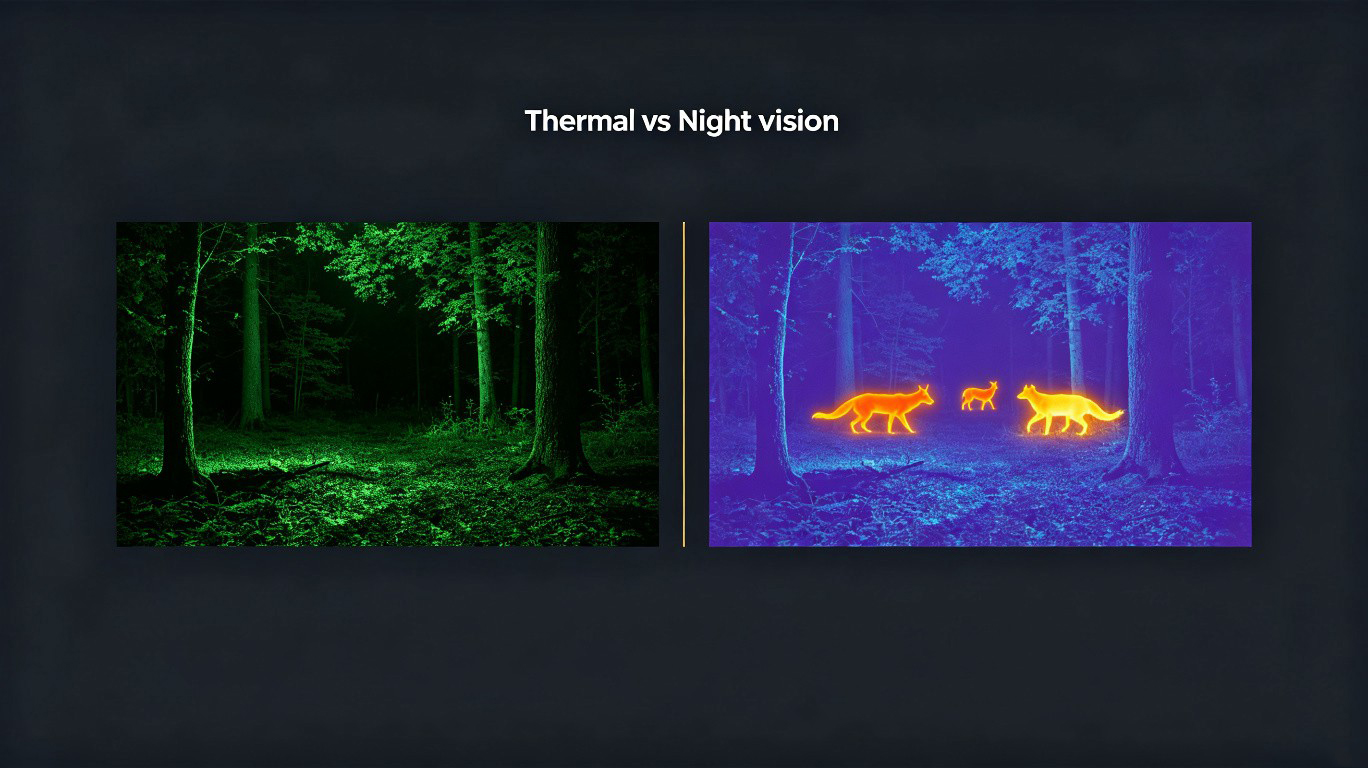
A thermal scope detects infrared radiation — heat — emitted by animals, humans, and objects. It converts temperature differences into a visible image. Because it relies on heat rather than light, a thermal imaging camera works in complete darkness, through light fog, smoke, and even light brush. It does not matter if the moon is out or if clouds block the stars. If a coyote is breathing, a thermal scope sees it.
Night Vision: Light Amplification
A night vision scope captures tiny amounts
Key Difference at a Glance
Thermal shows you where the heat is — perfect for detection, tracking, and scanning. It works in complete darkness and sees through light fog and brush.
Night Vision shows you what things look like — ideal for identification, navigation, and facial recognition. It requires ambient light to function.
of ambient light — moonlight, starlight, or infrared illumination — and amplifies it thousands of times into a visible green or black-and-white image. Night vision delivers more visual detail, making it easier to identify facial features, antler points, or specific animals. However, it requires at least some light to function and performs poorly in fog, rain, or dense woods where light is blocked.
Thermal vs Night Vision: Head-to-Head Comparison
| Category | Thermal Scope | Night Vision Scope | Winner |
|---|---|---|---|
| Works in total darkness | Yes — zero light required | No — needs ambient light or IR illuminator | Thermal |
| Detection range | 500–1,500+ yards depending on model | 100–400 yards with quality Gen 3 | Thermal |
| Target identification | Heat signature only; limited detail | Excellent — facial features, antlers visible | Night Vision |
| Performance in fog/smoke | Effective — limited penetration | Poor — light scatters | Thermal |
| Seeing through light cover | Yes — detects heat through brush | No — visually blocked | Thermal |
| Recoil resistance | Excellent — solid-state sensor | Moderate — image intensifier tubes fragile | Thermal |
| Battery life | 4–8 hours | 20–40+ hours | Night Vision |
| Weight | Compact and lightweight | Can be bulky with IR illuminator | Thermal |
| Entry-level price | $330–$800 | $400–$1,200 (Gen 2/3) | Thermal |
| Long-term durability | No tubes to burn out | Tubes degrade with bright light exposure | Thermal |
Which Is Better for Specific Hunting Scenarios?
Hog Hunting: Thermal Wins
Hogs are often active in dense brush, marshland, and agricultural fields where fog and vegetation are common. A thermal scope for hog hunting cuts through these conditions effortlessly. Hogs also run in groups, and tracking multiple moving targets demands a high refresh rate. The Owlshine OWS-300 with its 50Hz refresh rate and NETD ≤ 40 mK sensitivity is purpose-built for this application.
Coyote and Predator Hunting: Thermal Wins
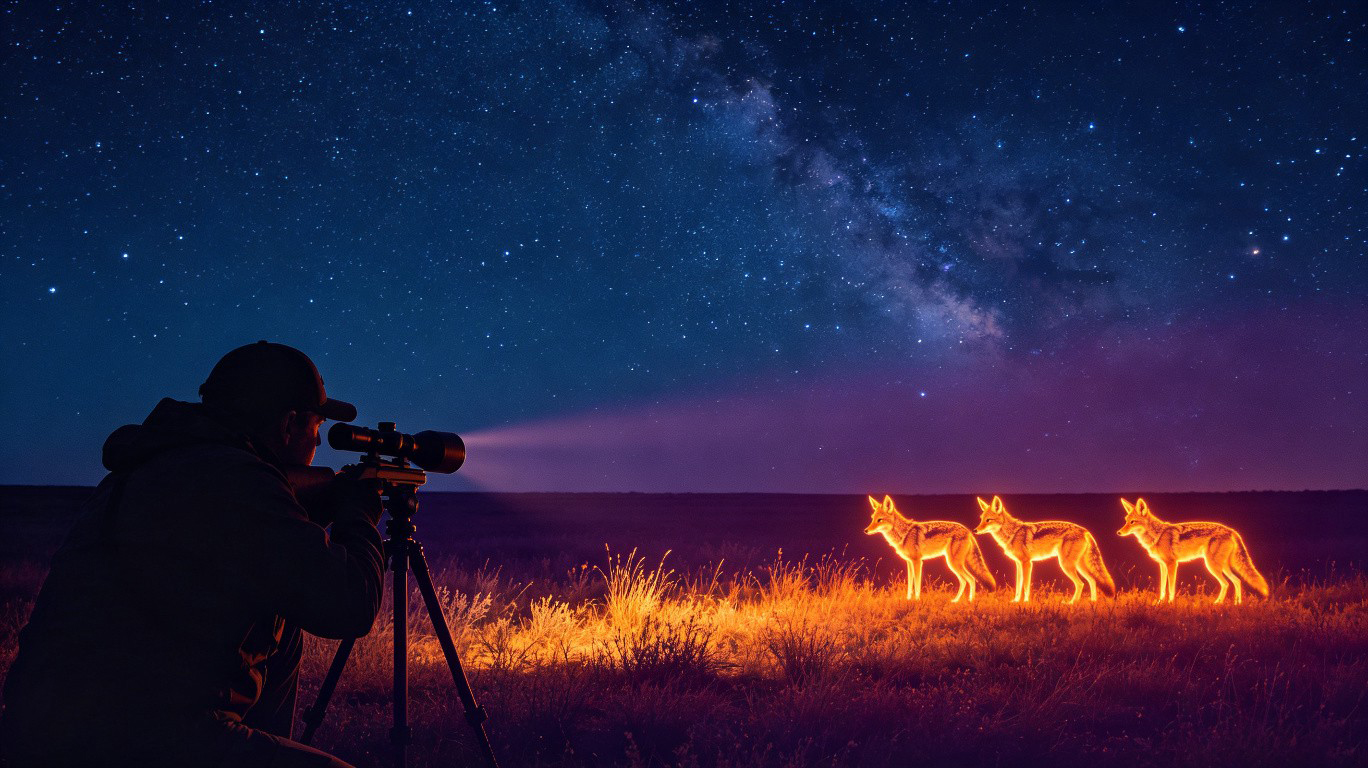
Coyotes are fast, wary, and often spotted at the edge of fields or on the move. A thermal scope for coyote hunting detects body heat at distances well beyond where night vision can identify movement. The ability to see through light grass and brush also gives thermal a massive advantage when predators are bedded down or partially hidden.
Deer and Big Game: Night Vision Has an Edge
If you hunt in areas where legal shooting hours end shortly after sunset and you need to confirm antler points or identify specific animals before pulling the trigger, night vision offers better visual detail. Thermal shows you *where* the animal is. Night vision helps you confirm *what* it is. Many serious hunters run both: thermal for scanning and detection, night vision for positive identification.
Security and Property Monitoring: Thermal Wins
For perimeter security, a thermal imaging camera detects intruders regardless of lighting conditions. Shadows, camouflage clothing, and darkness do not fool thermal. Night vision can be defeated with bright lights pointed at the scope or by total darkness in remote areas.
The Budget Reality: Thermal Is Now More Affordable Than Ever
Five years ago, night vision was the budget-friendly option and thermal was reserved for professionals with deep pockets. That has flipped. Modern uncooled thermal detectors have driven prices down dramatically.
Today, you can buy a quality compact thermal imaging camera like the Owlshine OWS-300 for $330. It delivers 320×240 resolution, 50Hz refresh rate, and NETD ≤ 40 mK — specs that cost $2,000+ just a few years ago. Entry-level night vision with comparable utility still starts around $400–$600 for Gen 2+ tubes, and Gen 3 night vision jumps to $1,500+.
For the money, thermal now offers more capability per dollar.
Can You Use Thermal and Night Vision Together?
Yes. Many advanced hunters and tactical operators use a technique called "fusion" or dual-system setups:
- Scan with thermal — Use a thermal monocular or scope to detect heat signatures across wide areas quickly.
- Identify with night vision — Switch to night vision for detailed confirmation before engaging or recording.
- Clip-on thermal — Some hunters mount a compact thermal imaging camera in front of a daytime riflescope, giving them thermal detection without re-zeroing.
The OWS-300's Picatinny rail compatibility makes it easy to integrate into multi-system setups. Swap it between rifles, helmets, or tripods in seconds.
FAQ: Thermal vs Night Vision for Hunting
Thermal is better for detection and tracking in most hunting scenarios. It works in total darkness, sees through light cover and fog, and detects animals at longer ranges. Night vision is better for detailed identification of antlers or faces. For pure hunting performance, especially predator and hog hunting, thermal wins.
Yes. Thermal scopes work 24/7 because they detect heat, not light. In daylight, warm animals still stand out against cooler backgrounds. Some hunters even prefer thermal during dawn and dusk when light conditions change rapidly, eliminating the need to switch between day optics and night optics.
A 320×240 thermal scope like the OWS-300 can detect a coyote-sized target at 400–600 yards under ideal conditions. Larger animals like hogs or deer can be detected at 600–900 yards. Detection range depends on thermal sensitivity (NETD), lens size, and weather conditions. Identification range is typically 30–50% of detection range.
No. Night vision performs poorly in fog, rain, and smoke because these conditions scatter the ambient light the device needs to amplify. Thermal imaging is far more effective in adverse weather because heat radiation passes through light moisture and particulates much better than visible light.
The Owlshine OWS-300 is the best budget thermal scope for hunting in 2026. At $330, it offers 320×240 resolution, 50Hz refresh rate, NETD ≤ 40 mK, and Picatinny rail mounting — outperforming competitors that cost twice as much.
Final Verdict: Choose Thermal for Hunting in 2026
For the vast majority of hunters — especially those targeting predators, hogs, and varmints — thermal imaging is the better investment in 2026. It detects more, works in more conditions, requires no light, and now costs less than quality night vision.
Night vision still has a place for detailed identification and navigation, but as a primary hunting tool, thermal has taken the lead. If you are building your first night-hunting setup or upgrading from outdated equipment, start with a reliable thermal scope for hunting like the Owlshine OWS-300. You will spend less, see more, and bag more game.
Ready to See the Difference?
Experience why hunters are switching to thermal. The OWS-300 delivers professional-grade night vision at a price that beats night vision scopes.
Shop the OWS-300 Thermal Scope →Related Articles:
How to Choose a Thermal Imaging Camera: Complete Buyer's Guide
How to Zero a Thermal Scope: Step-by-Step Guide
Best Budget Thermal Scope for Coyote Hunting in 2026