


The Challenge: Mold Temperature Control in Die Casting
In high-pressure die casting, mold temperature is not just a process parameter — it is the decisive factor between premium castings and costly scrap. Uneven mold temperatures cause cracks, sticking, cold shuts, and dimensional defects that plague automotive and aerospace manufacturers worldwide.
Traditional mold temperature measurement relies on discrete thermocouples installed at a handful of points. This approach has fundamental limitations:
- Point sensing misses spatial variation. A thermocouple tells you the temperature at one spot, not the full surface profile.
- Slow response time. By the time a thermocouple registers a problem, defective castings have already been produced.
- No historical traceability. Without continuous thermal records, root-cause analysis after quality incidents is nearly impossible.
At the 2026 CHINA DIECASTING & CHINA NONFERROUS expo in Shanghai, a new solution demonstrated how thermal imaging technology is solving these problems at scale.
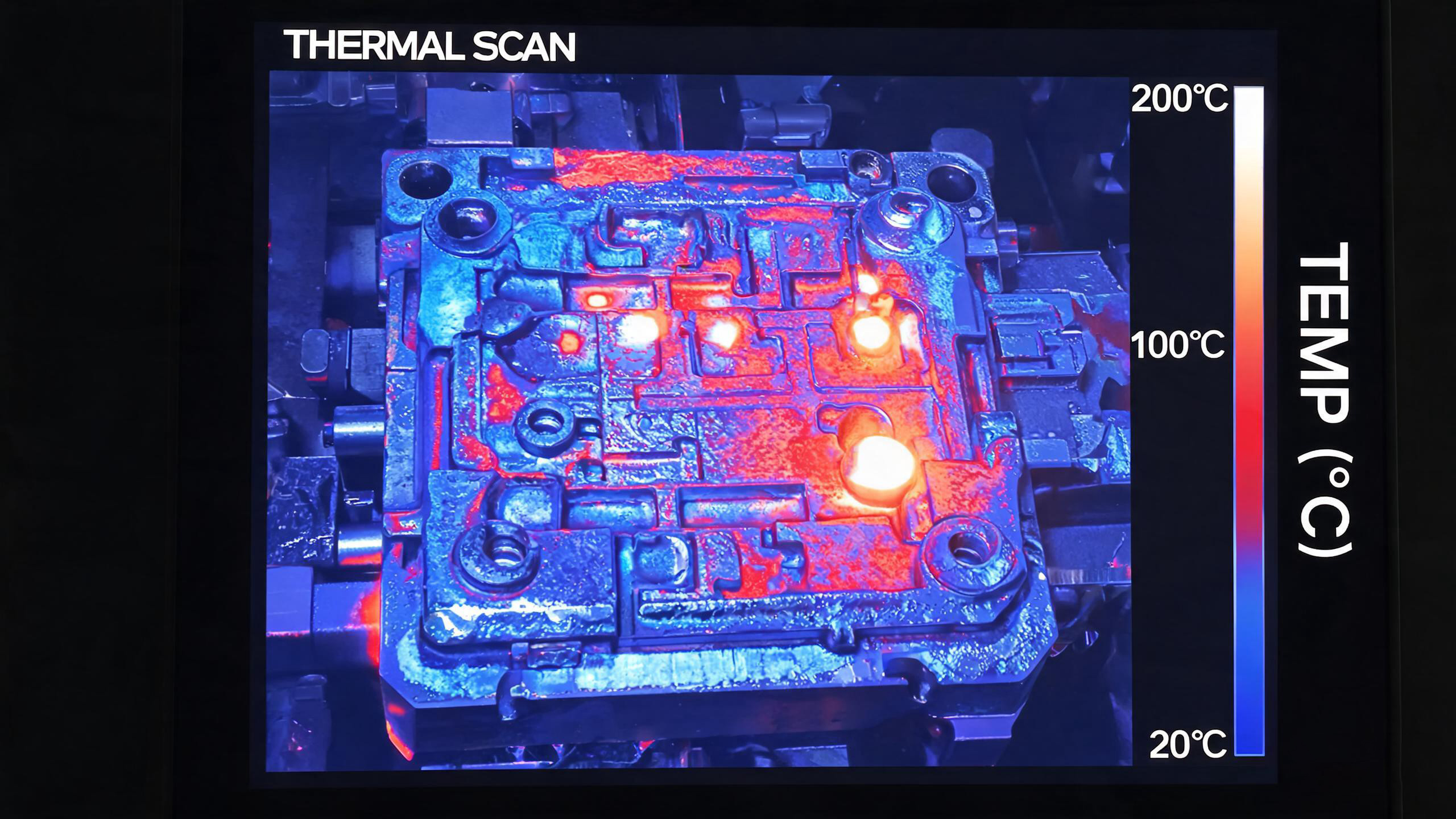
Fig 1: Thermal imaging reveals the full surface temperature map of a die casting mold, exposing hot spots invisible to point sensors.
How Thermal Imaging Vision Systems Work in Die Casting
The U-DTVS Die Casting Thermal Vision System showcased at the expo integrates online infrared thermal imaging, data visualization, and industrial IoT into a single real-time monitoring platform. Here is how it operates:
- Automated trigger: The system links to the die casting machine control via I/O signals. It automatically captures high-resolution thermal images at two critical process windows — after part extraction and after die spray.
- Surface temperature mapping: Instead of reading a few points, the thermal camera generates a full-field temperature distribution map of the entire mold surface.
- ROI & alarm thresholds: Operators define regions of interest (ROIs) and temperature limits. The system compares pre- and post-spray temperatures and triggers audio-visual alarms when limits are exceeded.
- Historical data archive: Every thermal image is automatically stored, creating a complete mold temperature record for each shot — enabling full traceability and trend analysis.
This closed-loop approach transforms mold temperature control from an art based on operator experience into a data-driven science. Owlshine industrial thermal cameras provide the sensor foundation for similar integrations.
Real Results: 3% Downtime Reduction and 0.8% Yield Improvement
The U-DTVS system delivered measurable performance gains in live production environments:
| Metric | Improvement | Annual Value (7000T Cell) |
|---|---|---|
| Equipment downtime | -3% | Significant labor and capacity recovery |
| Casting quality rate | +0.8% | Fewer defects, less rework |
| Annual ROI | — | ~740,000 RMB per 7000-ton cell |
For a large automotive supplier running multiple die casting cells, these numbers compound into millions of dollars in annual savings — while simultaneously improving product quality and reducing customer complaints.
Key Technical Advantages of U-DTVS Thermal Monitoring
Beyond basic temperature measurement, the system offers architectural advantages that make it uniquely suited to the harsh die casting environment:
B/S Architecture
Browser-based platform accessible from industrial touch panels, PCs, tablets, and smartphones — enabling centralized management across multiple plants.
IP54 + Adaptive Cooling
Main control unit rated IP54 with intelligent air control and adaptive cooling — built to survive extreme heat, humidity, and vibration.
Array Temperature Sensing
Replaces discrete thermocouples with a full-array temperature sensing network, capturing spatial thermal gradients in real time.
NADCA Compliant
Temperature uniformity monitoring logic designed in strict accordance with North American Die Casting Association (NADCA) standards.
Global Interest: Why International Buyers Are Investing
During the three-day CHINA DIECASTING expo, the U-DTVS booth attracted intense interest from buyers representing Thailand, Indonesia, Italy, Brazil, and South Korea. These international visitors were not merely curious — they were actively evaluating the technology for integration into their own die casting operations.
This global attention reflects a broader industry trend: as new energy vehicle (NEV) large-scale integrated die casting becomes mainstream, mold temperature control has evolved from a secondary consideration into a core quality determinant. Manufacturers who fail to adopt real-time thermal monitoring risk falling behind competitors who can guarantee tighter tolerances and higher consistency.
Choosing Thermal Imaging for Your Die Casting Operation
If you are evaluating thermal imaging for die casting mold monitoring, prioritize these specifications:
- Temperature range: Must cover 50°C to 600°C with ±2°C accuracy across the mold surface
- Spatial resolution: Sufficient to resolve temperature differences of 2-5°C between adjacent mold regions
- Frame rate: 30Hz or higher to capture rapid thermal transients during spray and extraction cycles
- Environmental sealing: IP54 minimum to survive molten metal splatter, oil mist, and vibration
- Integration capability: Digital I/O, OPC-UA, or Modbus TCP for PLC connectivity
Owlshine industrial thermal cameras offer rugged, high-speed infrared sensors specifically designed for metal casting and forging environments. Contact our engineering team for integration support.
Frequently Asked Questions
A: For surface temperature monitoring, yes. Thermal imaging provides superior spatial coverage and faster response than point thermocouples. However, embedded thermocouples may still be useful for measuring internal die temperatures at specific depths.
A: Industrial thermal cameras for die casting feature protective housings with air purge and water cooling. IP54-rated enclosures with automatic lens cleaning systems ensure continuous operation in the harshest foundry environments.
A: Yes. As die release agent coatings degrade, local thermal resistance changes cause measurable surface temperature shifts. Thermal imaging can detect these patterns and alert operators to re-coating needs before quality degrades.
Upgrade Your Die Casting Quality Control with Thermal Imaging
From compact fixed-mount sensors to fully integrated vision systems, Owlshine delivers industrial thermal cameras engineered for the extreme demands of die casting and metal forming.
Explore Industrial Thermal Cameras